

Shark has been making a significant impact in the air purifier market for a while now, offering various innovative, high-quality devices. In this review, I will thoroughly review the Shark HP102 air purifier. What’s interesting is that I haven’t previously used any of Shark’s products, which adds an extra layer of excitement to this review.
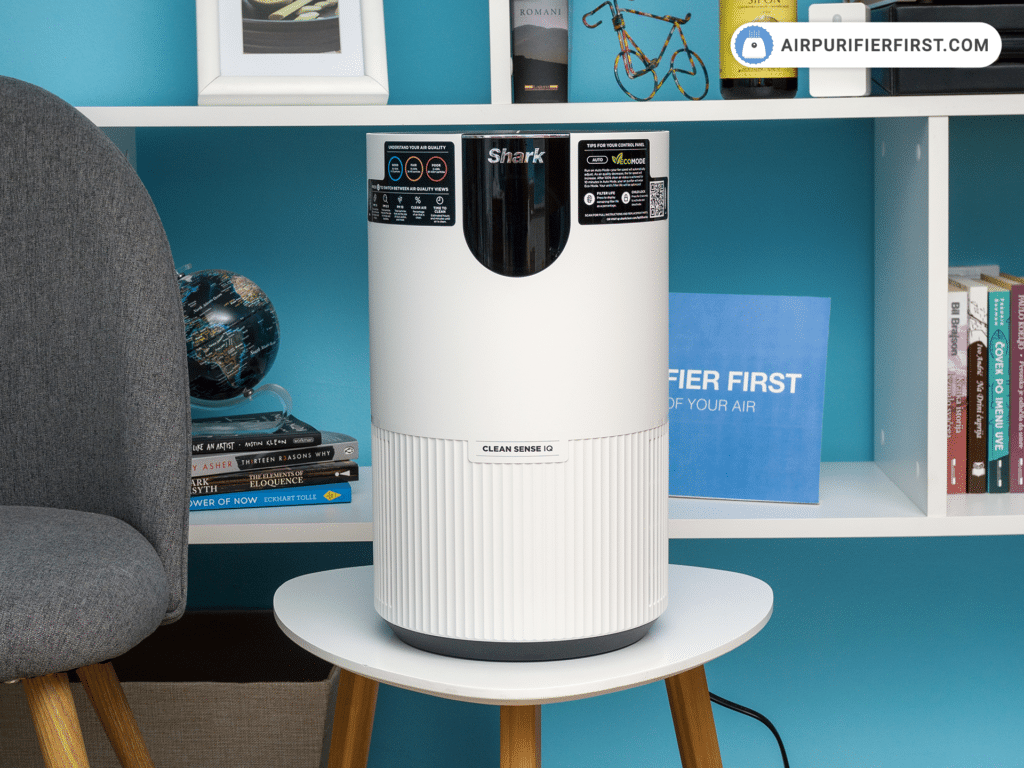
Table of Contents
- In a Hurry? Here’s a Quick Summary of the Shark HP102!
- Specifications
- Setup and Installation
- Design
- Features Overview
- Air Quality Indicator & Air Info
- Room Coverage & CADR
- Filtration Technology
- How to Replace Shark HP102 Filter?
- Noise Test
- Performance Tests
- Operating Costs
- Shark HP102 Air Purifier – Video Review
- FAQ on Shark HP102
- Pros and Cons
- Final Thoughts
This compact air purifier is intended for rooms up to 124 sq. ft. In a room of mentioned size, it can clean the air nearly five times within an hour. The Shark HP102 uses a 3-stage filtration system and doesn’t have an ionizer. Moreover, it’s CARB-certified and completely safe to use. It also boasts several advanced features, such as an air quality sensor, air quality indicator, and auto mode. Yet, it lacks smart app connectivity, which is, in my opinion, a slight setback.
While Shark has seemed slightly short in certain areas, it has also exceeded expectations in others. For example, it made extraordinary results in performance tests.
Altogether, the Shark HP102 is a fantastic air purifier with some great features and outstanding performance. I believe it’s highly competitive in its category, which we will see in many comparisons that I will publish after finishing this review.
In a Hurry? Here’s a Quick Summary of the Shark HP102!
- Room Coverage: The Shark HP102 is a perfect air purifier for small rooms, up to 124 sq. ft. in size.
- Outstanding Filtration: This air purifier uses a three-stage filtration technology consisting of a pre-filter, an activated carbon filter, and a True HEPA filter.
- Many Features: It boasts many advanced features, such as an air quality sensor, an air quality indicator, and an auto mode, among many others.
- Excellent Performance: It improved the air quality in a 194 sq. ft. room by about 92% in just one hour.
- Warranty: Shark provides a two-year warranty on this air purifier.
Specifications
In the table below, I singled out the most essential specifications of this air purifier.
| Manufacturer | SharkNinja |
| Model | HP102 |
| Dimensions | 8.7 x 8.7 x 14.6 inches (22 x 22 x 37 cm) |
| Weight | 5.85 lb (2.65 kg) |
| Filters | Pre-filter, Activated Carbon Filter, and True HEPA Filter |
| Filter Longevity | 6-12 months |
| Room Coverage (4.8 ACH) | 124 sq. ft. (11.5 m²) |
| Number of Working Modes | 4 – Speed 1, Speed 2, Speed 3, and Speed 4 |
| Power Consumption | 24W |
| Warranty | 2-year |
Setup and Installation
Like most air purifiers I’ve previously tested, the Shark HP102 requires some preparation before its first start.
To begin with, you need to unpack the device from the shipping box and then peel off all the protective tapes from it. Following this comes the most important part – preparing the filter.
To make the filter ready: you have first to flip the air purifier upside down, remove the filter from the device, unpack it from the plastic wrap, and place it back into the device. By completing this step, your Shark air purifier is fully prepared and ready for use.
Now, you can place the device in your desired location, plug it into a power source and turn it on.
Design
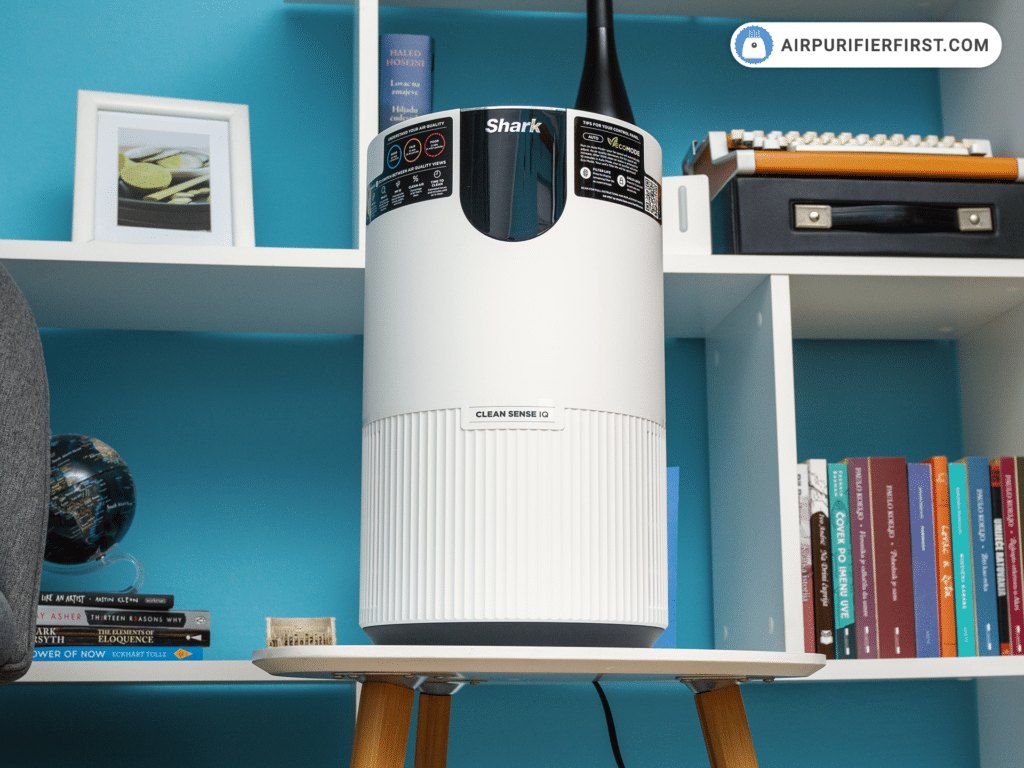
At first glance, this air purifier seems like a typical cylindrical device commonly seen among most small-to-medium-sized air purifiers. However, Shark has integrated some innovative features, high-quality materials, and details that make it more interesting than the typical air purifiers on the market.
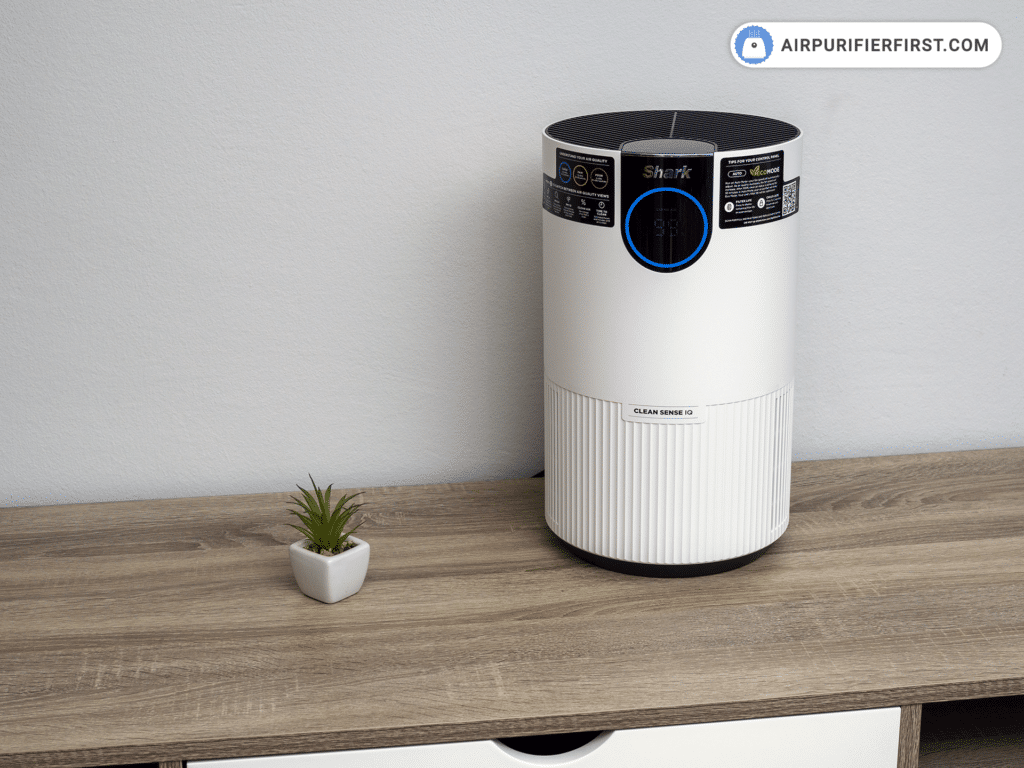
The model I purchased for testing purposes is white, with black grilles on top and a black control panel and display, making it very appealing and eye catchy.
The Shark HP102 consists of two parts: the lower part, which features air intake vents and houses the filter, and the upper part, which contains the motor, air quality sensor, control panel, and fan grilles.
Regarding the design in general, I find it quite appealing. The device is very similar to competing devices in this category, but Shark added some details that add a touch of elegance. The build quality is excellent, as is the quality of the plastic. Everything is in place, the device is well assembled, and there are no irregularities such as rattling or deviations.
One potential drawback is the lack of a carry handle. However, given that this is a portable and lightweight device, I believe you will be okay with moving it from room to room.
All in all, this is a compact air purifier with an interesting design that I’m sure will fit into almost any home environment.
Controls and Indicators
The controls are placed on the top of the device. There you can find buttons, indicators, and a display.
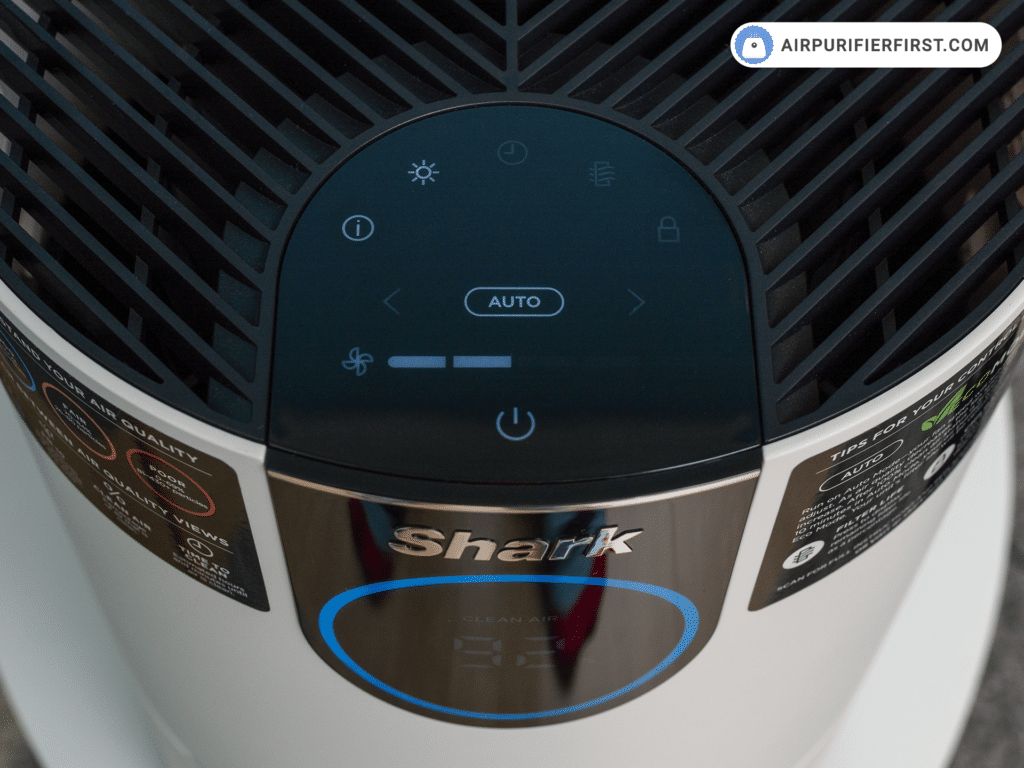
The buttons you can find on the control panel are: power, air info, brightness, timer, filter life, child lock, fan speed, and auto mode button. They are touch sensitive, with a good level of sensitivity and a perfect layout that ensures you’ll encounter no issues during operation.
Moreover, the LED indicators are also easily readable, and overall, I’m absolutely pleased with how Shark has designed this control panel.
Airflow
The Shark HP102 is characterized by a cylindrical shape, and we can say that it consists of two parts.
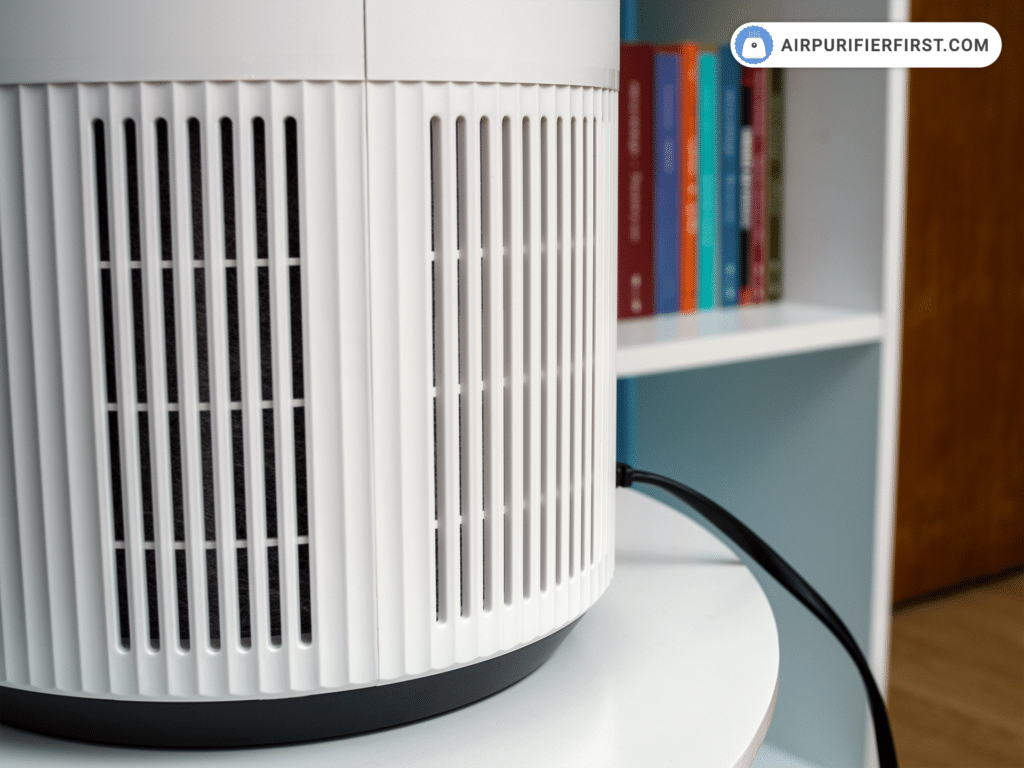
The lower part is where the air intake vents are located, which, unfortunately, are not 360-degree – the front/and some other parts are fully closed. The device draws in air through these vents, which is then filtered and exits through the grilles on the upper side.
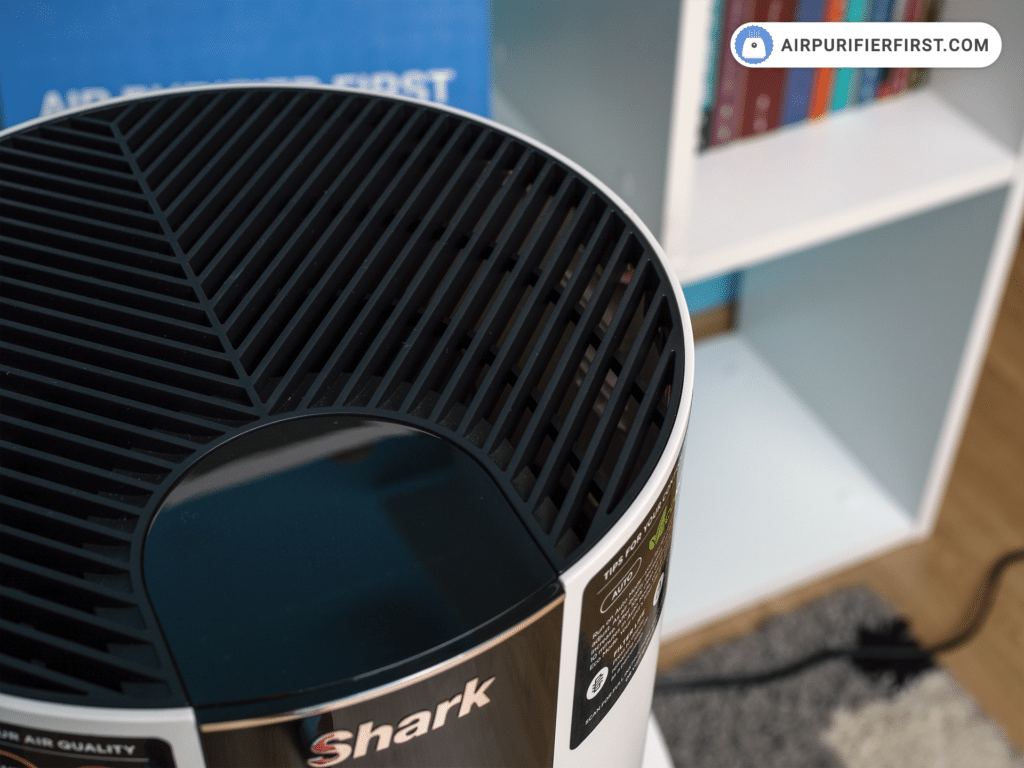
I have one piece of advice to remember, especially for first-time air purifier users. Please be careful when placing your air purifier and ensure you never block the air intake/outtake vents, as doing so could potentially damage the air purifier.
Size and Dimensions
With a weight of just 5.85 lbs (2,65 kg), the Shark HP102 air purifier is a light and portable device. Its dimensions are a compact 8.7 x 8.7 x 14.6 inches (22 x 22 x 37 cm).
This is an incredibly lightweight and easy-to-move air purifier, although it lacks a carrying handle for effortless transportation.
What You Will Get in the Box
Inside the box of your newly purchased device, you’ll find: one Shark HP102 Air Purifier, a 3-in-1 Filter (pre-installed), and a User Manual.
Before starting the air purifier, you have to take a few important steps that I explained in detail at the beginning of the review. Jump to the Shark HP102 setup and installation guide.
Features Overview
The Shark HP102 is a smart air purifier equipped with plenty of advanced features. However, it lacks connectivity to a smart app, a feature that would raise this device to the next level.
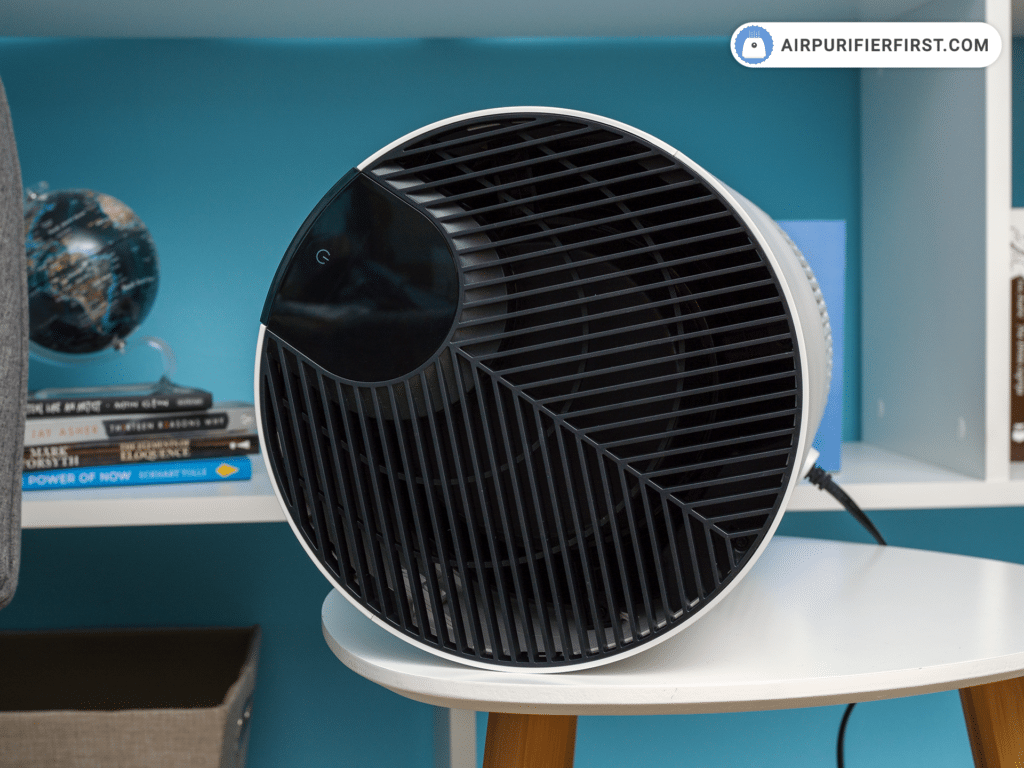
Among this device’s unique options, I think the air quality sensor, air quality indicator, auto mode, and high-quality display are the most important ones.
Air Quality Sensor
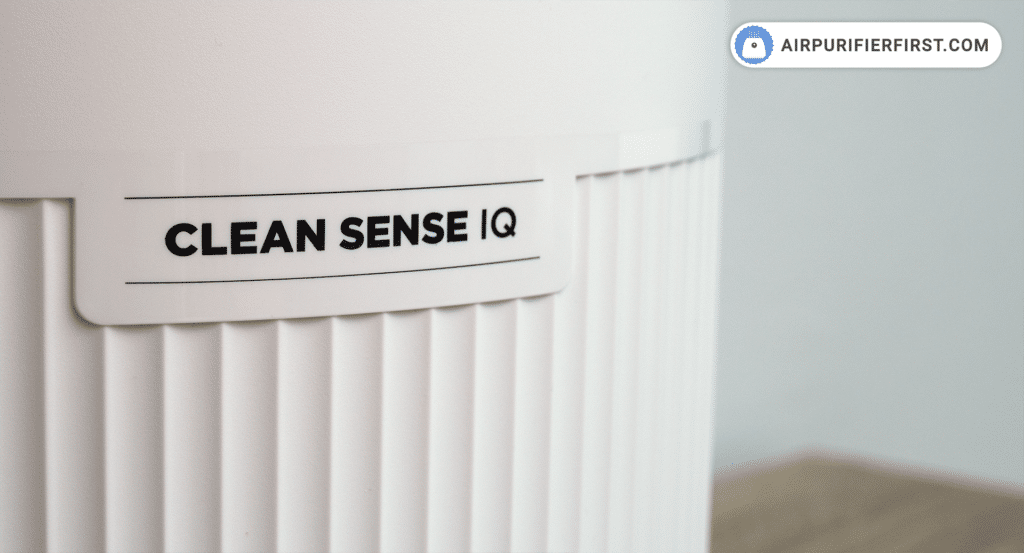
The Shark HP102 Air Purifier has an air quality sensor that measures air quality in real time. This sensor uses Shark’s Clean Sense IQ technology. Every Shark model that uses Clean Sense IQ has this mark printed somewhere on itself, which is printed on the front in this case.
A standout feature of the Shark air quality sensor is its ability to detect PM1, PM2.5, and PM10 particles. This unusual characteristic makes this sensor one of the most powerful in the market. I haven’t tested many air purifiers that can detect PM1 particles. For comparison, some popular air purifiers like the Levoit Core 300S or Core 400S only detect PM2.5 particles, so in my view, detecting PM1 particles gives the Shark air purifier a significant edge.
Additionally, I’d like to highlight that this sensor functions in combination with other device features, such as the air quality indicator and auto mode.
However, there is a potential issue I found about this sensor. It is positioned on the upper side of the device, and it’s integrated in such a way that it’s challenging to access and nearly impossible to clean it. This, I believe, can potentially affect the sensor’s long-term accuracy, making it less accurate over time.
Air Quality Indicator & Air Info
As previously mentioned, the Shark HP102 air quality sensor works in combination with some other features, one of which is the Air Quality Indicator. It is simply a display showing real-time air quality readings from the sensor.
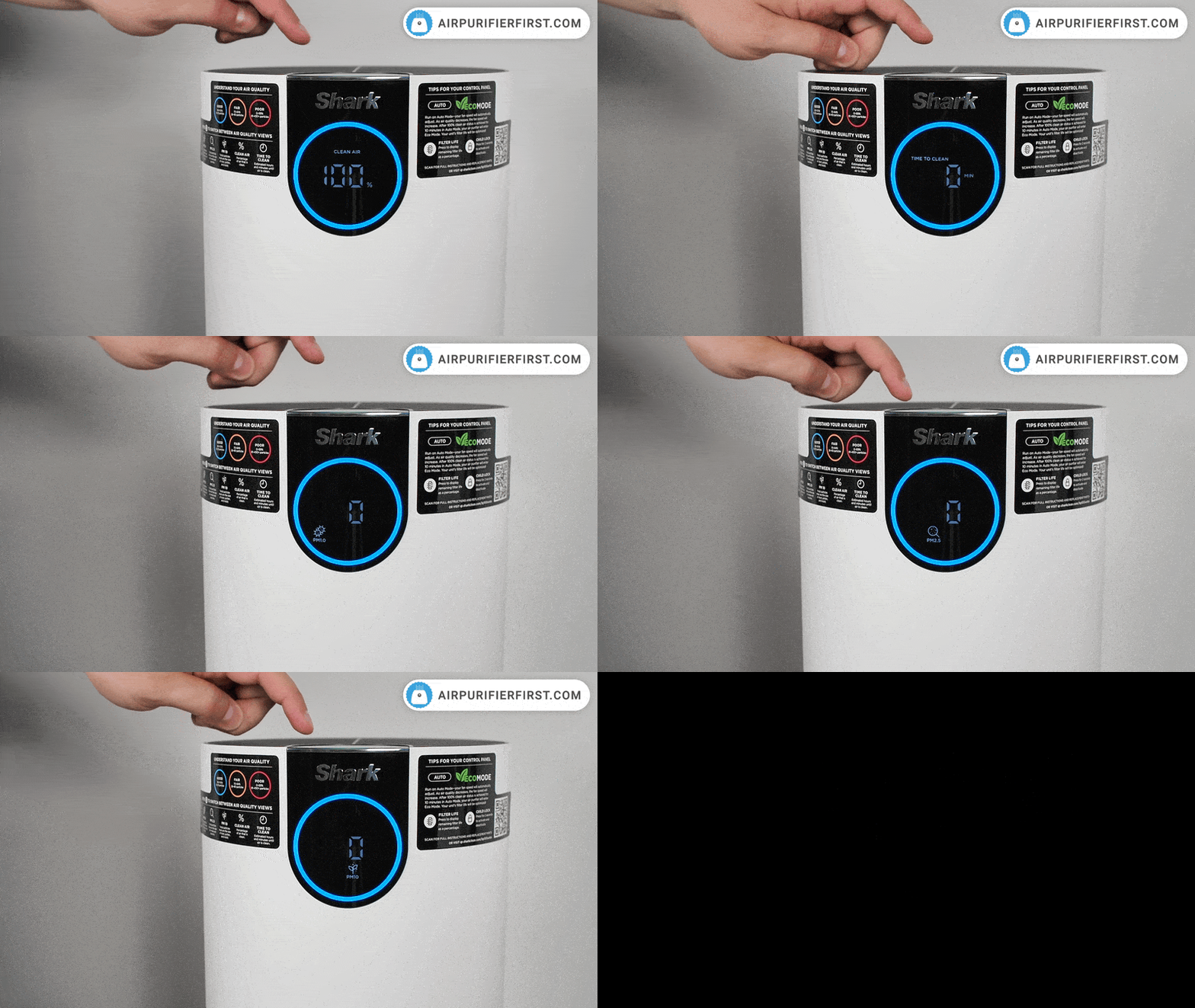
It’s located on the front of the device and can show different air quality data. You can simply select what you want to be shown on the display by pressing the Air Info button.
Each press on this button changes the mode of displaying the current air quality. For example, you can choose Shark to display:
- % CLEAN AIR: Displays the current air quality rating in percentages. According to Shark, ‘CLEAN AIR uses particulate matter (PM) Air Quality Standards as determined by the EPA to calculate the air quality rating.’ If you see values between 0%–69% on display, the air quality in your home is poor; if it is 70%–84%, the air quality is fair, and if it’s between 85%–100%, the air quality in your home is good.
- TIME TO CLEAN AIR (min): This is the next parameter that can be shown on display, which shows the estimated time (in minutes) needed for the Shark HP102 air purifier to clean the air in your room. I like this one!
- PM1: By choosing this option, the device will display the amount of PM1 particles in the air, including viruses and ultra-fine allergens.
- PM2.5: This option shows PM2.5 particles in the air, including smoke and bacteria.
- PM10: Displays PM10 particles in the air, including dust, mold, and pollen. I must say that this, along with the Smartmi P1, is the only air purifier that displays the amount of pollen in the air, which I have had the opportunity to test.
In the table below, you can see what every color on the LED ring means. It is a ring around the display that shows the current air quality lighting in a different color.
| Color | Air Quality | Suggestions |
|---|---|---|
| Red | Poor (0–69%; 81–430+particles) | A red ring means your air quality is poor, with a high level of particle concentration. For better results, increase fan speed or select Auto Mode. |
| Amber | Fair (70–84%; 26–80 particles) | An amber ring means your air quality is fair, with a moderate level of particle concentration. For better results, increase fan speed or select Auto Mode. |
| Blue | Good (85–100%; 0–25 particles) | A blue ring means your air quality is good, with a low level of particle concentration. |
In summary, I believe that almost any user of this small air purifier will be even more satisfied when they directly see on the display how the air quality in their home increases when using the Shark air purifier.
Auto Mode
Auto Mode is yet another feature on this device that works in combination with the air quality sensor. Specifically, when in Auto Mode, the Shark HP102 will adjust its fan speed based on the current air quality in the room.
This highly convenient feature allows you to set the air purifier and forget about it while ensuring optimal air quality in your home at all times.
ECO Mode
ECO Mode is another very useful feature designed to save electrical energy costs, save the filter and extend its lifespan.
When the device is switched to Auto Mode and the clean air status maintains a 100% rating for at least 10 minutes, it will switch to ECO Mode. This transition not only boosts energy efficiency but also helps maintain the longevity of your air purifier’s filter.
Brightness
As the name suggests, the Brightness Button serves to adjust the brightness of both the control panel and the display. There are three levels available: full brightness, partially dimmed, and fully dimmed. Each press of the button cycles through these options.
Keep in mind that the brightness indicator and power button will always light; however, their intensity will correspond with the selected brightness setting. This means you can’t completely dim them, but their light will adjust based on your chosen brightness level.
Timer
The Timer function is yet another feature built-in in this air purifier. Essentially, the timer can be set anywhere from 0 to 12 hours, defining the period after which the device will automatically power off.
By pressing the timer button, the selected time is displayed on the front display. This visualization allows you to see the remaining time, any time.
Filter Life Indicator
This indicator notifies you when it’s time to replace the old filter. When the filter life indicator lights up, you should replace the old filter on the device as soon as possible (I have explained the filter replacement procedure in the following part of the review).
However, this indicator is also used as a button, and by holding your finger on it for 3 seconds, you reset the filter life indicator.
Child Lock
This is a great option if you have small children and want to prevent accidental changes to the set options.
The option is activated easily by holding your finger on the child lock button for 2 seconds, and it’s deactivated in the same way. When the child lock is active, the device will not respond to pressing any other button.
Warranty
Shark provides a limited warranty for this model for two years, which is standard and in line with other manufacturers.
What I would recommend to everyone is to register and activate the warranty on the Shark website immediately after purchasing the product.
Room Coverage & CADR
When it comes to room coverage of this small device, things get a bit complicated, primarily because the manufacturer suggests using the device in 500 sq. ft. rooms. However, in a room of this size, this Shark unit only achieves 1 ACH (air changes per hour), meaning it will clean the air in a 500 sq. ft. room once every 60 minutes.
Considering that the industrial standard for ACH is 4.8, we have come to a much different recommendation than what Shark emphasized. In fact, I would recommend using this device in rooms up to 124 sq. ft., as in a room of these dimensions, the unit achieves a 4.8 ACH. This is something you must think about, especially if the room in which you plan to use the air purifier is highly polluted.
Honestly, I am surprised by the low airflow and coverage of this device, especially since I haven’t come across a large number of air purifiers with this or similar coverage. One that comes to my mind is the Levoit LV-H132, which covers almost identical rooms to the Shark HP102.
Overall, I conclude that the Shark HP102 is ideal for small rooms such as small bedrooms, small kitchens, offices, kid’s rooms, and similar spaces.
Filtration Technology
The Shark HP102 uses a 3-stage filtration technology consisting of a pre-filter, a True HEPA filter, and an activated carbon filter.
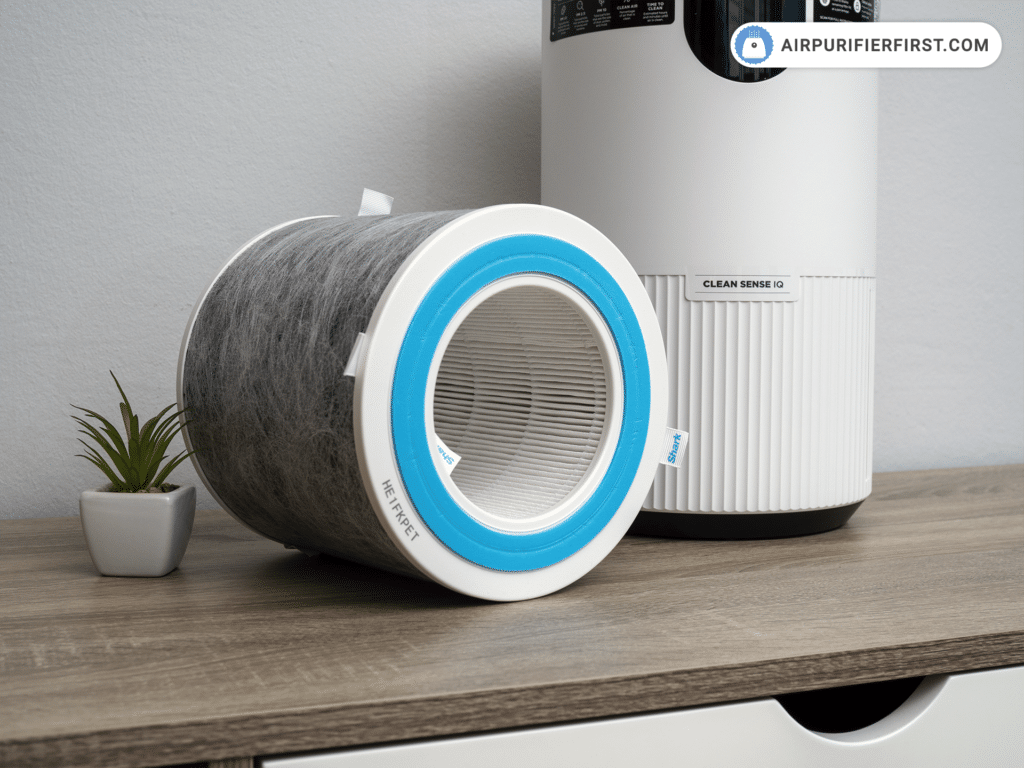
The filter is cylindrical in shape and hollow through the middle. It takes almost half of the device and is placed inside the bottom part of the device.
One thing that I would especially highlight is to occasionally rotate the filter to the other side to ensure even soiling. This is necessary because the airflow openings on this device aren’t spread on all sides, so the filter may become unequal dirty, which significantly affects both performance and the filter’s life.
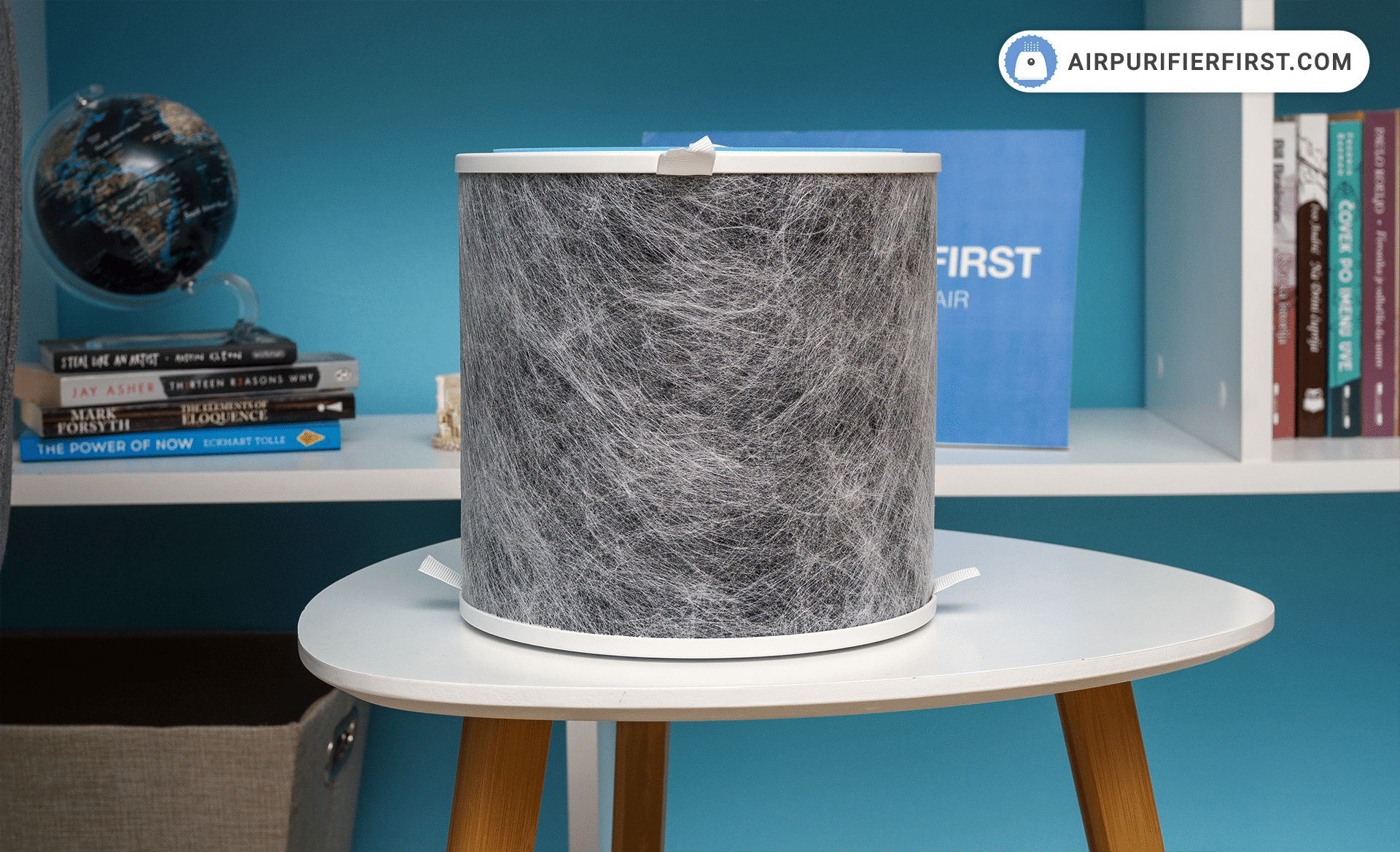
Shark HP102 Replacement Filter
Always buy genuine filters for the best performance. As soon as the filter life indicator is on, you are ready to change filters. Do it as quickly as possible.
Check Filter Price On AmazonPre-filter
The pre-filter is the first stage of filtration, and its main purpose is to capture larger particles such as pet hair, lint, dust bunnies, and more.
By doing so, this filter prevents these particles from reaching the HEPA filter, thus extending its lifespan and providing more efficient air filtration.
The pre-filter is practically attached to the HEPA filter and looks like a spider’s web mesh.
Activated Carbon Filter
The Shark HP102 air purifier uses an activated carbon filter as the second filtration stage. This filter is pellet-based, and its primary function is to capture cooking and other odors, volatile organic compounds (VOCs), and formaldehyde.
Essentially, the use of a pellet-based carbon filter is a significant advantage, as these filters have shown much better performance in tests compared to ordinary fibrous filters coated with carbon.
Like every air purifier I test, I have also used this one for some time in the rooms where I spend time, and I must say that I’m very satisfied with the performance of this carbon filter.
It has also demonstrated excellent performance in neutralizing the smell of matches, which I have also tested. It was much quicker and more effective in removing the match odor compared to, for example, the Xiaomi 4 Compact or Renpho air purifiers.
True HEPA Filter
The final and undoubtedly the most important filtration stage in this device is the True HEPA filter.
The True HEPA filter removes 99.97% of airborne particles as small as 0.3 microns in size. This filter will remove particles such as dust, cigarette and wildfire smoke particulate, mold spores, and more.
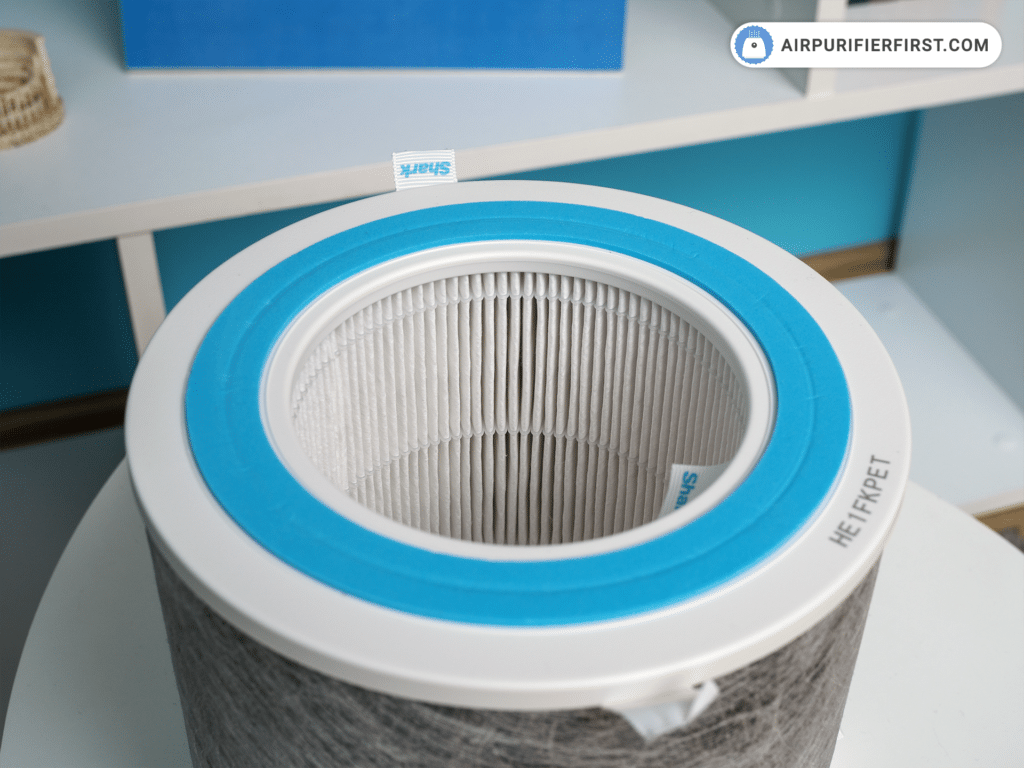
What is interesting/confusing here is that the manufacturer claims that this filter removes 99.98% of particles based on IEST-RP-CC007.3, as small as 0.1-0.2 microns. I have sent an email to Shark to get proof or confirmation of this information. Unfortunately, I haven’t received it, so I can’t confidently state that this filter captures 99.98% of particles.
Nevertheless, the Shark HP102 has shown excellent results in all tests, for which I am certain the True HEPA filter is primarily responsible.
How to Replace Shark HP102 Filter?
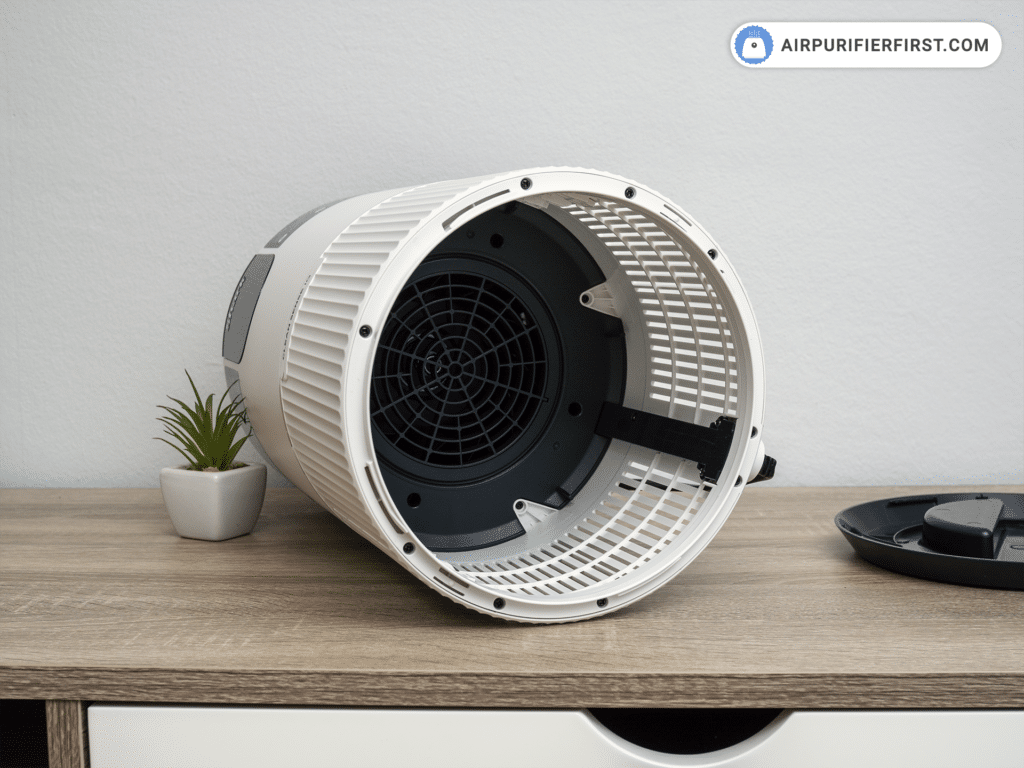
The Shark HP102 doesn’t use a washable filter, which means you will need to replace it from time to time.
The manufacturer advises replacing the filter on average between 6 and 12 months. However, if you notice that the filter has significant dirt, strange odors, or unusual operation, you can change it before it is necessary.
Shark has a filter life indicator on the control panel, which will notify you when it’s time to replace the filter. Again, if you notice the filter is dirty before the filter reset indicator lights up, I recommend changing it regardless.
The procedure for replacing the filter is quite simple and consists of just a few easy steps.
Noise Test
The Shark HP102 has four different fan speed settings, and for the purpose of noise testing, I measured the noise level produced by the device at each speed individually. I used a specialized tool to measure the noise level, which quantifies the sound intensity emitted by the device on the dBA scale.
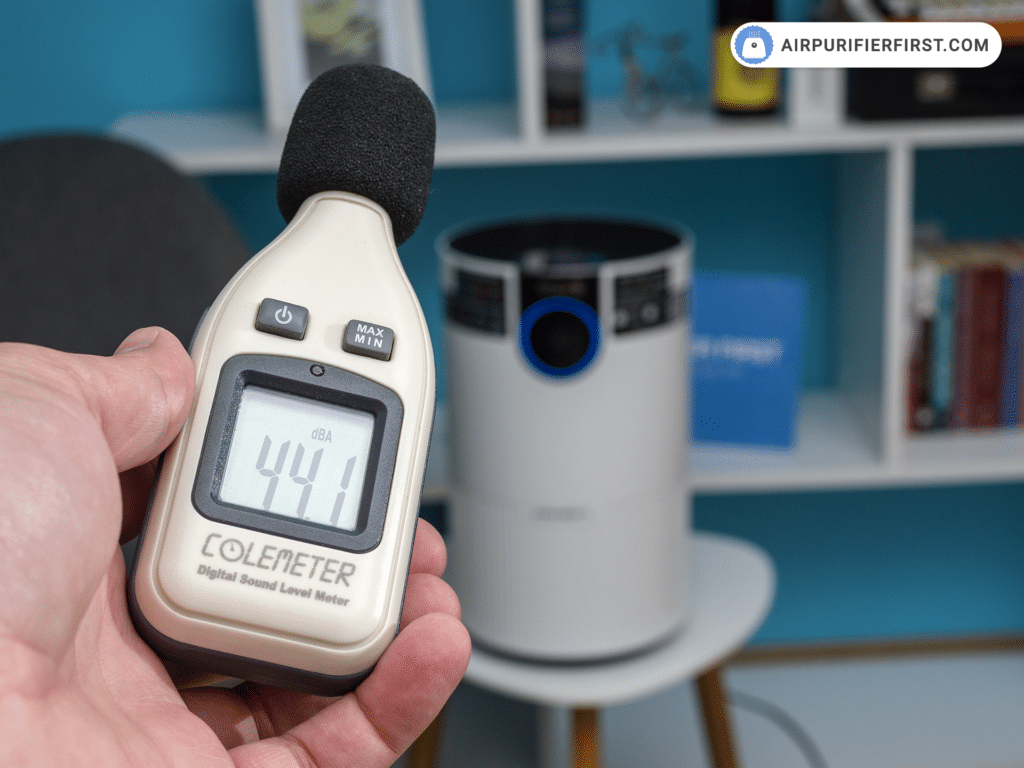
What is interesting is that the Shark HP102 is not very loud at the maximum speed, but it also doesn’t have a high airflow like some competing devices. For comparison, the Levoit Core 300S is much louder at max speed than the Shark, but it also has higher airflow.
At its maximum speed, the Shark HP102 produces a sound of only 56.5 dBA, which, combined with its very quiet operation at other speeds, makes it one of the best choices for a bedroom.
It is worth mentioning that the sound level at the lowest speed is pretty well optimized, with the device producing an incredible 41.7 dBA. The table below shows the sound levels produced by this air purifier at different speeds.
| Speed | Value (dBA) |
|---|---|
| Speed 1 | 41.7 dBA |
| Speed 2 | 44.8 dBA |
| Speed 3 | 48.9 dBA |
| Speed 4 | 56.5 dBA |
Overall, the Shark HP102 is a very quiet air purifier that uses a well-optimized motor, making it hardly noticeable during work at most speeds.
Performance Tests
The Shark HP102 is a compact air purifier designed for rooms up to 124 sq. ft. However, the manufacturer suggests using this device in slightly larger rooms, which I personally wouldn’t recommend in every situation, but only when the air in the larger room is not heavily polluted.
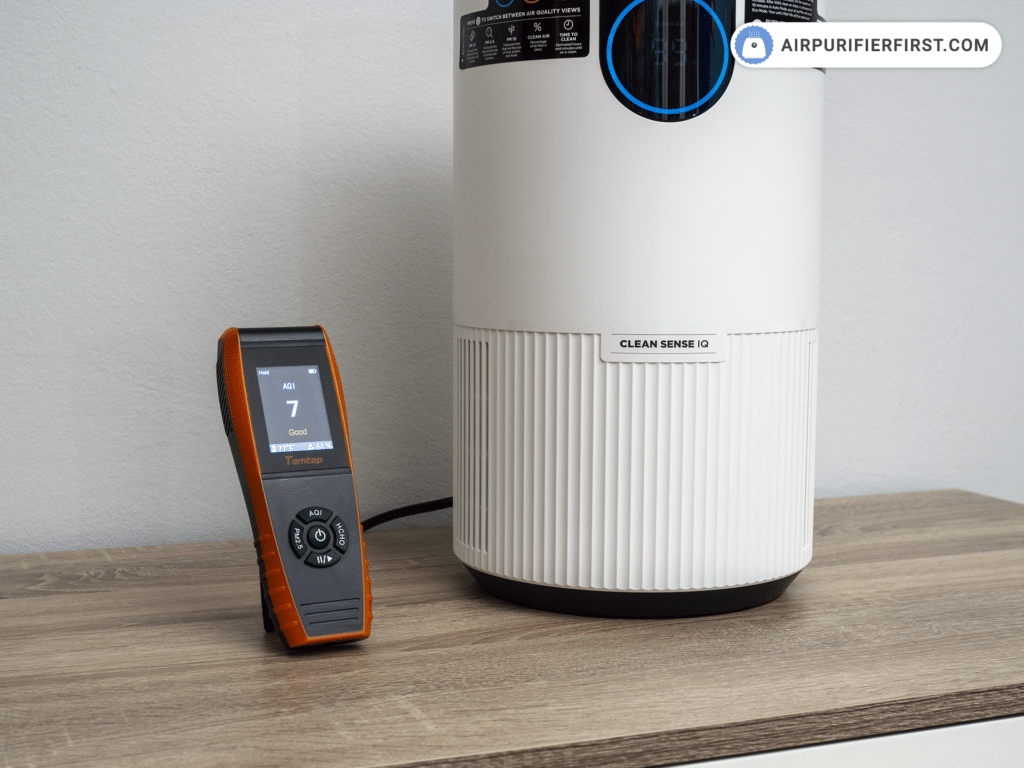
Based on the capabilities of this air purifier, I tested it in two different-sized rooms that were approximately within the recommended dimensions. I performed the test using a Temtop laser particle meter, which I use for all my reviews.
Additionally, I tested the Shark HP102 in everyday conditions for some time, as well as in specific conditions with high levels of VOCs and similar pollutants. In those scenarios, the air purifier performed exceptionally well, confirming the quality of its filters.
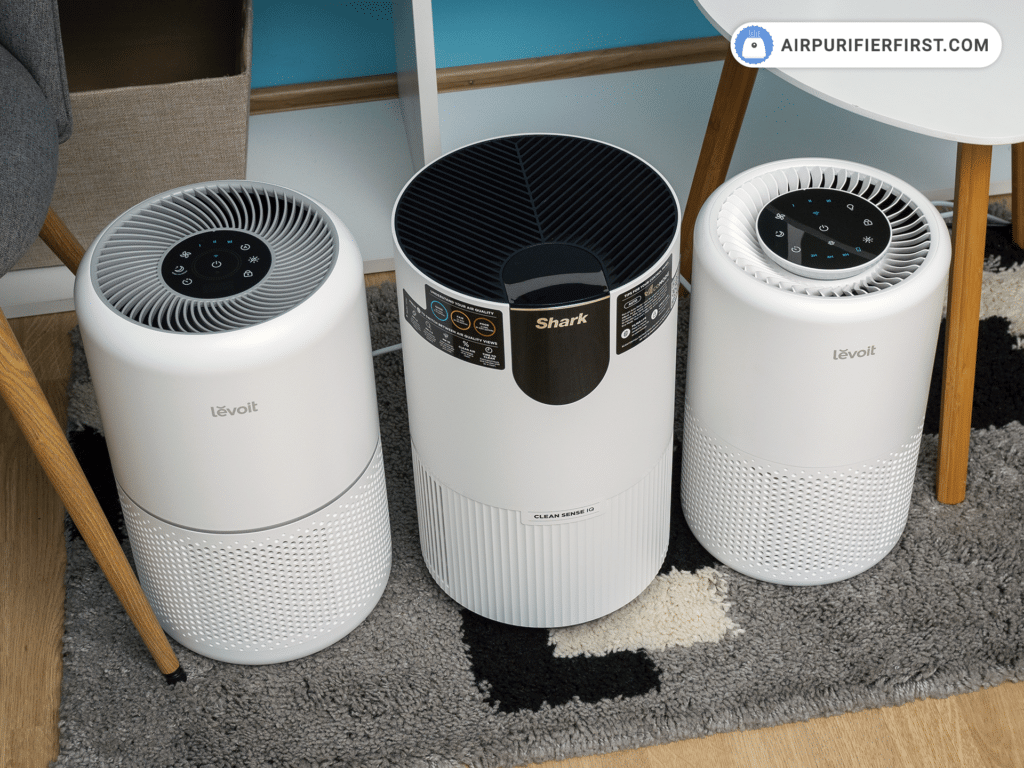
Without further ado, let’s move on to the test results in the rooms where I tested this device.
120 sq. ft. Room Test
In the first test, in a room of 120 sq. ft., which is nearly identical to the recommended dimensions, I let the Shark HP102 run at maximum speed for 60 minutes. During this time, the device improved the air quality by an impressive 94%.
| # | Starting Baseline | After 60min |
|---|---|---|
| PM 2.5 | 102.6 | 7.9 |
| PM 10 | 143.6 | 11 |
| Particles | 148778 | 11473 |
| AQI | 132 | 8 |
This result is much better than I expected, confirming that the Shark HP102 is a highly competitive and well-made air purifier.
194 sq. ft. Room Test
In the second test, this time in a room of 194 sq. ft., which is slightly larger than the recommended dimensions, this air purifier also made impressive results. In just 60 minutes of operation at maximum speed, the Shark HP102 improved the air quality by an incredible 92%.
| # | Starting Baseline | After 60min |
|---|---|---|
| PM 2.5 | 101.7 | 8 |
| PM 10 | 142.4 | 11.2 |
| Particles | 147549 | 11659 |
| AQI | 133 | 11 |
Overall, we can agree that Shark has achieved fantastic results in both tests, demonstrating its capabilities and filtration technology.
Operating Costs
The Shark HP102 is a very low-power consumer due to its well-optimized motor, with a power of just 24W. With this motor, the Shark will consume no more than 20.5W at maximum speed.
Let’s do some math! Imagine leaving the Shark HP102 running at the max speed for 24h daily for one month. In that case, your electrical bill would be increased by about $1.8. This is not a huge cost, do you agree? What’s more, this is the calculation for running at the max speed, meaning that it will cost you even less if working on auto mode or other speeds, which will definitely be the case.
You can refer to the table below for the consumption in kW/h.
| Speed | Power Usage (W) |
|---|---|
| Standby | 0.3W |
| Speed 1 | 4.8W |
| Speed 2 | 6.5W |
| Speed 3 | 11.3W |
| Speed 4 | 20.5W |
However, such a small motor also brings some drawbacks, for instance, a lower airflow, which makes this air purifier ideal for small rooms up to 124 sq. ft.
In addition to the electricity costs, there is also the cost of replacement filters, which need to be changed on average every 6-12 months depending on usage. To prolong the filters’ longevity, I recommend using this air purifier whenever possible (if not always) in auto mode.
Although the Shark HP102 consumes very little power, I must admit that I was shocked by the extremely high price of replacement filters, which makes this air purifier less cost-effective annually, especially compared to competing devices.
Shark HP102 Air Purifier – Video Review
Watch a full video review of the Shark HP102 air purifier.
FAQ on Shark HP102
Does the Shark HP102 produce ozone?
No, the Shark HP102 doesn’t produce ozone. Additionally, this device is CARB certified, confirming its safe for use and compliant with strict California regulations.
How often should you change the filter on the Shark HP102?
Shark suggests changing the filter on average every 6 to 12 months, which is okay, especially knowing that the replacement filter for this air purifier isn’t that affordable.
Does the Shark HP102 work with a smart app?
Unfortunately, this air purifier doesn’t work with the smart app.
Does the Shark HP102 come with a remote control?
According to the specifications and user manual, this air purifier should come with a remote control. However, the unit I purchased for testing purposes didn’t come with a remote control.
Whether this is an error in the product description or some other issue, I don’t know. But I am certain that a remote control would make the daily use of this small device easier, especially since you have to press the buttons directly on the control panel if you want to change any setting.
What is the warranty period for the Shark HP102?
The Shark HP102 comes with a 2-year warranty.
Pros and Cons
To revise, here are the advantages and disadvantages of the Shark HP102:
Leave a Reply