

Temtop LKC-1000S is a device that can tell you in a matter of seconds how good is air in your home. This simple device is actually not that simple if you look at how it works, but it is simple to use, and everyone can check air quality without a hassle.
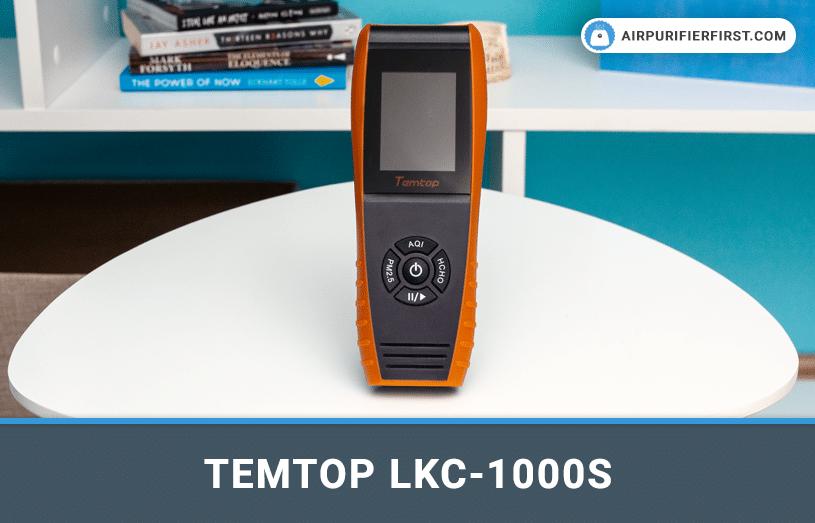
Table of Contents
This robust device can give you seven crucial pieces of information about the air. With a Temtop air quality detector, you can get info about PM2.5, PM10, particles, AQI, temperature, humidity, and HCHO. This device is seven in one, and because of that, it is definitely worthy.
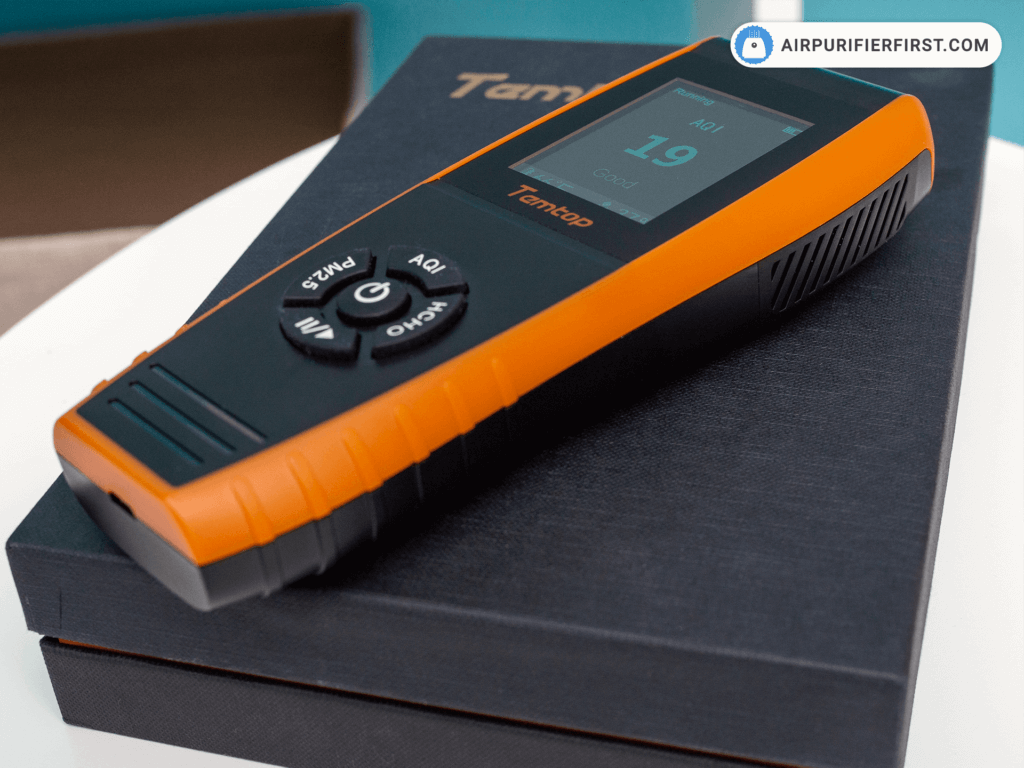
Temtop uses 3rd generation particle sensor in this model, and that just guarantees accurate results.
Temtop LKC-1000S is a fantastic device that can give you exact pollution results. On top of that, you can also monitor the humidity level and temperature.
Advanced particle detection sensors guarantee fast and exact pollution monitoring.
Getting Started
Before you start using the Temtop LKC-1000S, you need to calibrate it. In other words, you need to let it rest for 8 hours in a ventilated environment. This process is also required if you didn’t use it for a longer time. After calibration is done, you need to keep the room airtight for 10 minutes. Air pollution will be different in a different location in the room, measure all locations, and take the average number as average overall air quality. Once you are done with measuring one room, you can immediately go and measure other parts of the home. Temtop LKC-1000S is fast at detection, and in a few moments, you can get correct air quality for a whole house.
Important Tips
Sensors may get damaged if you let this device run for a longer time in a room with a high concentration of formaldehyde (over 1.0mg/m3) or PM concentration higher than 500ug/m3. Oil and high concentration gases or contact with organic solvents such as silica gel, paintings, drugs, and other adhesives may damage sensors too. High humidity levels may interfere with detection accuracy. Some interferences are also possible with high levels of benzene, ammonia, ethanol, and other chemicals that may be present in the air. Also, keep in mind that you should never cover air inlet/outlet because that will have a negative effect on detection accuracy.
Design
LKC-1000S is built with high-quality plastic that is durable but as well gentle in hand. The device is well designed; black and orange colors blend nicely. LCD is large enough to see all the numbers. You can monitor various things on the LCD. You can simply see the numbers or watch the graph in real-time and see how air quality is different in real-time. The device is small (7 x 2.6 x 1.3 inches) and because of that easy to handle.
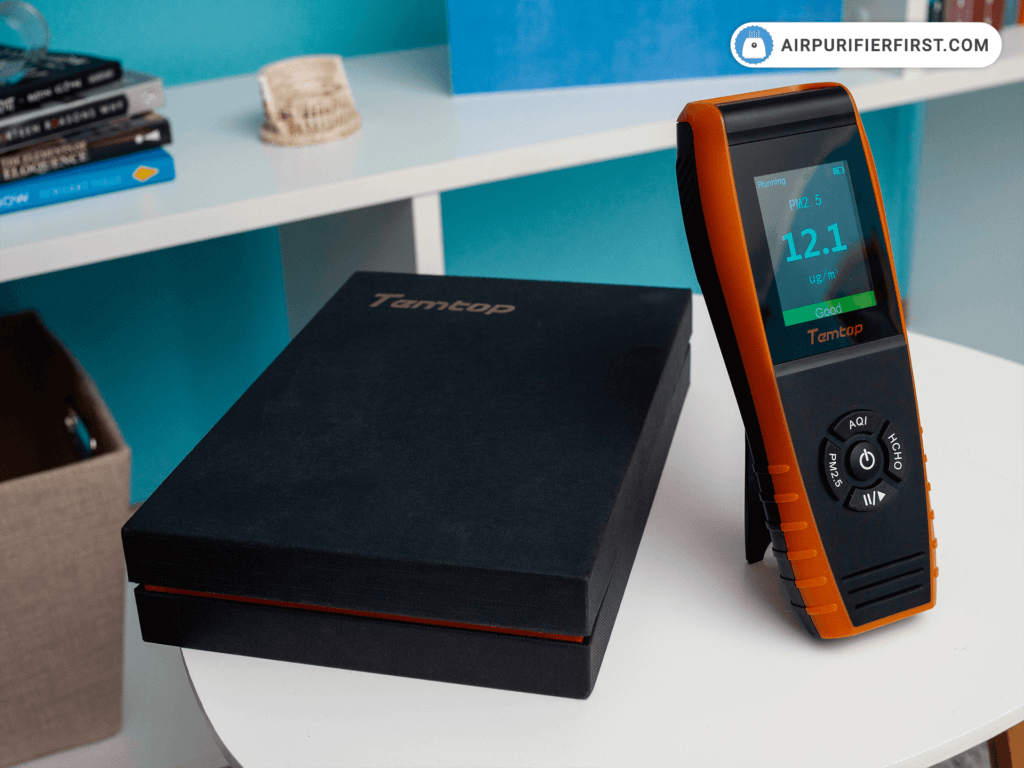
Usually, this device is used in hand, but it also has legs to stand on its own on a table or other hard surface. In a word, this is a high-quality device with a fantastic design.
Buttons
Buttons are sensitive enough and ideally placed. The device is simple to use, and because of that, buttons are also simple. Below you can see what each button does.
Turn on/off the detector
Press and hold for two seconds to turn it off or on.
AQI
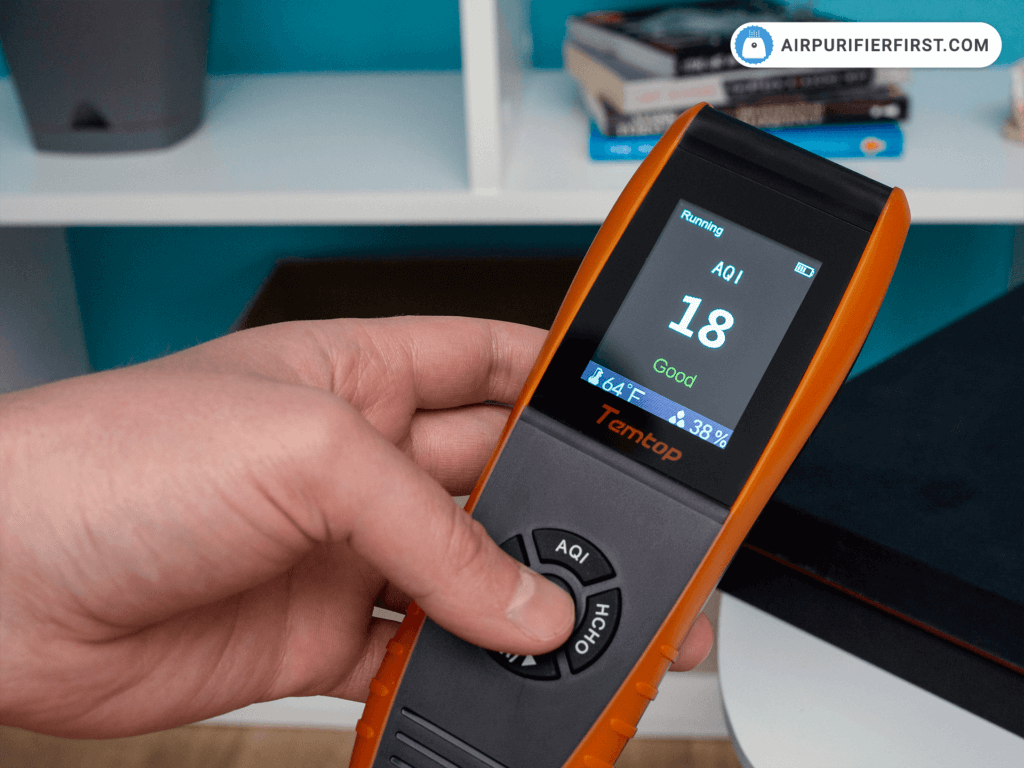
Pressing the AQI button, you will see AQI index, temperature, and humidity of the room.
PM2.5
This button is used for particle detection. Press it, and it will show PM2.5, press it again, and you will see results for PM10 and other particles on the screen.
HCHO
Pressing the HCHO button, you will see the formaldehyde display interface.
Pause/Play Button
While in “Running” mode, if you press pause/play button device will enter detection pause mode and values are maintained. If in a “Hold” mode, you press this button device will enter real-time detection mode.
Accessories and parts
When you buy this device, you should get one black premium box, main product, USB cable, and user manual. USB cable is used to power up the battery in the device. You can connect it to any cell phone charger, laptop, PC, or any other device that has a USB port.
Features
AQI Detection
AQI index is one of the widespread air quality indexes, it is used all over the world. With a single number, you can detect if the air in the room is good or no.
HCHO Detection
HCHO concentration is crucial if you have suspicions that dangerous formaldehyde may be present in the room. No matter of suspicions of it you should regularly check this number.
Particles Detection
Particles in a home are common. Unfortunately, small PM2.5, as well as PM10 particles, can be extremely dangerous to our health, especially if we stay in an environment with a high level of these particles for a longer time. With Temtop LKC-1000S, you can see PM2.5, PM10, and particle count on one screen. Below the numbers, you can also read air quality.
Temtop LKC-1000S is extremely useful in everyday use, no matter if you want to measure air quality indoors or outdoors.
Particle detection is done thanks to a laser particle sensor, which is extremely accurate and fast at measurement.
Graph View
The graph view is used to monitor the air in visual form; you can visually see if the air quality with time is dropping or raising.
Other Info
This device also monitors humidity levels and temperature.
How Temtop LKC-1000S Works
The whole process of detecting air quality is pretty simple. Air enters the device from one side and goes out on the other side. But before it goes out, sensors installed inside the device will detect air pollution.
Bellow, you can see a table with measuring ranges:
| Type | Measuring Range |
|---|---|
| PM2.5 | 0~999 ug/m³ |
| PM10 | 0~999 ug/m³ |
| HCHO | 64.9 dBA |
| Temperature | 0-50 ℃ |
| Humidity | 0-90% RH |
If left inactive for one hour, Temtop LKC-1000S will automatically shut down.
PROS AND CONS
To revise, here are advantages and disadvantages of Temtop LKC-1000S:
Pros
Cons
Summary
Knowing air quality in your home is very beneficial. With such knowledge, you can act and bring the overall air quality in the home up. With Temtop LKC-1000S, you will exactly know what type of pollution is present in the air. You will also know if the air quality is dangerous. And when you finally bring air quality on the desired level, you can still use this device to monitor temperature and humidity levels in the room.
Temtop air quality device is useful even if you use it outside. If you are living in a big city where outside pollution may concern you, with Temtop LKC-1000S, you will know the exact pollution of the outside air in a matter of seconds.
Update Log
April 13, 2021 – I fixed some typos.
Leave a Reply